The context of this traffic stop is critical. On April 6, 2004, at about 3:30 a.m., officers responded to reports of gunshots in Nickerson Gardens, a large, low-income public housing complex in Southeast Los Angeles north of the I-105 Freeway, bordered on the east side by Compton Avenue and the south by Imperial Highway. There are over 1,000 living units and its grounds resemble military housing on a military base.
In 2004, the Bounty Hunter Bloods gang was active in Nickerson Gardens. There were about 600 members of the gang registered with law enforcement, plus many more members who were not registered.
Mr. McDaniel and Kai Harris were members of the Bounty Hunter Bloods. When police responded to the scene, they entered a unit through a back door and saw the bodies of Anderson and Williams. Anderson was shot at close range in the face. Brooks also died at the scene from multiple gunshot wounds, five in his face, fired from close range. Williams survived, with wounds to her mouth, arms and legs. Another victim, Johnson, survived, but with gunshot wounds to his face and range.
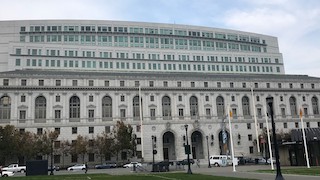 California Supreme Court San Francisco
Five days later, police made a routine traffic stop at 120th Street and Central Avenue (near Nickerson Gardens) of a blue Toyota without a license plate. McDaniel was in the right front passenger seat, but police did not yet know he was a suspect in the Nickerson Gardens shooting. When the Toyota driver pulled over, McDaniel immediately got out of the car. The police officer making the traffic stop ordered McDaniel to get back in the car and McDaniel complied.
The police officer then arrested the driver for driving without a driver’s license and decided to impound the vehicle. The officer then returned to the vehicle to inventory the vehicle before it was towed and asked McDaniel to exit the vehicle.
The officer testified that he noticed a bulge in McDaniel’s pocket that “resembled a gun.” He then patted down McDaniel and retrieved a loaded Ruger semiautomatic handgun and a separate loaded magazine. The bullet cartridges recovered from McDaniel matched the bullet cartridges found at the shooting and a police examiner determined the gun was one of the weapons used at the murder.
McDaniel was then arrested and, at trial, McDaniel moved to suppress the gun and ammunition as being the fruit of an illegal search in violation of his Fourth Amendment rights.
The trial court judge denied the motion and on appeal, the California Supreme Court affirmed the trial court. It explained, quite methodically, how a seizure of the driver and passenger takes place under the Fourth Amendment when police pull over a vehicle for a traffic infraction. Brendlin v. California (2007) 551 U.S. 249, 251. Police may then order the driver, as well as the passenger to exit the vehicle. Pennsylvania v. Mimms (1997) 434 U.S. 106, 111 (police may pull out driver after a valid traffic stop); Maryland v. Wilson (1997) 519 U.S. 408, 410 (extending Mimms to passengers).
McDaniel argued that Terry v. Ohio (1968) 392 U.S. 1 governed, requiring that the officer have “an articulable suspicion” and be able to point to “specific and articulable facts, which, taken together with rational inferences from those facts, reasonably warrant” the stop to detain the passenger of a lawfully stopped vehicle. Id., at 21 and 31.
The California Supreme Court responded, citing to Arizona v. Johnson (2009) 555 U.S. 323, which observed that Mimms, Wilson and Brendlin “cumulatively portray Terry’s application in a “traffic-stop setting” and “confirm[ed]” that “the combined thrust” of those three decisions is “that officers who conduct ‘routine traffic stop[s]’ may ‘perform a “pat down” of a driver and any passengers upon reasonable suspicion that they may be armed and dangerous.’” Johnson, at pp. 331-332.
Under these circumstances, the California Supreme Court found the search and seizure of McDaniel was legal and that the denial of the motion to suppress was legally correct.
We present this summary because a passenger will often call us about something police found on him or her during a traffic stop and the passenger asks if the officer had legal authority to perform such a search. This opinion explains when such conditions exist.
The citation for the California Supreme Court ruling discussed above is People v. Don’te Lamont McDaniel (2021) 12 Cal. 5th 284.
For more information about reasonable suspicion to conduct a search, please click on the following articles:
 Greg Hill & Associates Home















 Compton Courthouse
 Your Privacy Choices Cookie Policy Manage Cookies


